
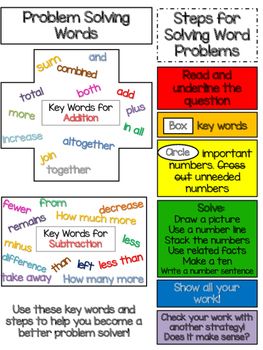
Mathematical word problems help students connect classroom mathematics with real-life situations. They encourage learners to interpret information, identify relationships, choose appropriate operations, and explain their reasoning. However, many students find word problems difficult even when they can perform calculations correctly. They may struggle to understand the wording, determine what the question is asking, or decide which mathematical strategy to use.
Teachers can address these challenges by teaching math word problem solving strategies explicitly and systematically. Instead of asking students to search for keywords and guess an operation, educators can help them understand the situation, organize the information, represent relationships visually, and check whether their answers make sense.
This guide explores practical methods for teaching mathematical word problems, including step-by-step problem-solving routines, visual models, worked examples, classroom activities, and assessment strategies. These approaches can help students develop mathematical confidence, independent reasoning, and stronger problem-solving skills.
Why Do Students Struggle With Mathematical Word Problems?
Word problems require students to use several skills at the same time. They must understand written language, remember relevant information, recognize mathematical relationships, select a strategy, perform calculations, and interpret the result.
Understanding the reasons behind these difficulties helps teachers provide more effective support.
1. Difficulty Understanding the Language
Some word problems contain unfamiliar vocabulary, long sentences, or situations students have not encountered before. Students may understand the mathematical operation but misunderstand what the problem describes.
For example, the phrase “How many more books does Sara have than Ali?” asks students to compare two quantities. A learner who does not understand the comparison may choose an operation incorrectly.
Teachers can help by explaining important vocabulary, reading problems aloud when appropriate, and asking students to describe the situation in their own words.
2. Confusion About Which Operation to Use
Students sometimes believe that certain words always indicate a specific operation. They may associate “more” with addition or “left” with subtraction without considering the entire problem.
However, the same word can appear in different mathematical situations. A problem involving “more” might require subtraction when students are comparing two quantities.
Students need to understand the relationship between the quantities rather than rely exclusively on keywords.
3. Difficulty Identifying Relevant Information
A word problem may include several numbers, details, or conditions. Students must determine which information is necessary and how the quantities relate to one another.
For example, a problem about buying notebooks may mention the number of notebooks, the price of each notebook, and the money available. Students must understand which quantities are needed to answer the question.
Drawing a diagram or organizing information in a table can make these relationships easier to see.
4. Weak Understanding of Mathematical Concepts
Some students struggle because they have not fully understood the underlying mathematical concepts. A learner who does not understand multiplication as equal groups may find a problem about arranging objects in rows confusing.
Teachers should connect word problems with concrete objects, drawings, number lines, and familiar mathematical ideas before expecting students to solve unfamiliar problems independently.
5. Difficulty With Multi-Step Problems
Multi-step problems require students to complete one calculation before using its result in another. Students may understand each individual operation but struggle to determine the correct sequence.
Breaking the problem into smaller questions and recording intermediate results can help students organize their thinking.
8 Essential Math Word Problem Solving Strategies
A consistent problem-solving process gives students a reliable way to approach unfamiliar questions. Teachers can introduce the following eight strategies gradually and encourage learners to use them independently.
1. Read the Problem for Meaning
The first step is understanding the situation, not immediately calculating an answer.
Ask students to read the problem carefully and, if necessary, read it again. Encourage them to identify who or what is involved, what is happening, and what information the problem provides.
Example:
“Lena has 18 stickers. Her friend gives her 7 more stickers. How many stickers does Lena have now?”
Before calculating, students should explain that Lena starts with 18 stickers and receives an additional 7.
This establishes the meaning of the problem before introducing the mathematical operation.
Teacher prompts:
- What is happening in this problem?
- What do we already know?
- What changes during the situation?
- Can you explain the problem in your own words?
Students who can explain the situation are better prepared to choose a meaningful strategy.
2. Identify What the Question Is Asking
Students should identify the unknown before selecting an operation.
In the sticker example, the unknown is Lena’s total number of stickers after receiving more.
In other problems, the unknown might be the number of items in a group, the difference between two quantities, the number of equal groups, or the cost of several items.
Ask students to underline or rewrite the actual question. They can then state what their answer needs to represent.
This strategy prevents a common error: calculating a quantity that appears in the story but does not answer the question.
Classroom activity: Give students short word problems and ask them to write only what each problem is asking. They do not need to solve the problems until they can identify the unknown correctly.
3. Organize the Important Information
Once students understand the situation, they should organize the information needed to solve it.
They can use a simple table, labeled notes, a drawing, or a list of known and unknown quantities.
For example:
| Information | Value |
|---|---|
| Stickers Lena has initially | 18 |
| Additional stickers | 7 |
| Total stickers | Unknown |
This format clarifies the relationship between the known values and the missing quantity.
However, teachers should avoid encouraging students to remove every detail that does not look numerical. Contextual information may explain important conditions or relationships even when it does not directly appear in the calculation.
The goal is to organize information meaningfully, not simply to circle numbers.
4. Use Drawings and Visual Models
Visual representations help students translate written situations into mathematical relationships. Depending on the problem, they might draw objects, create a bar model, use counters, or sketch a number line.
Example:
“Sam has 12 marbles. His brother has 5 more marbles than Sam. How many marbles does his brother have?”
A student can draw a bar representing Sam’s 12 marbles and then extend the brother’s bar by another 5.
The model shows that the brother’s quantity consists of Sam’s quantity plus an additional amount.
This supports the equation:
[
12+5=17
]
Visual models are particularly helpful when students struggle to distinguish between comparison, combination, equal-group, and change problems.
Teachers should model how to create and interpret diagrams rather than assuming that adding a picture to a worksheet will automatically improve understanding.
5. Identify the Mathematical Relationship
Before choosing an operation, students should explain how the quantities relate to one another.
Common relationships include:
- Combining quantities: Two or more groups form a total.
- Changing a quantity: An amount increases or decreases.
- Comparing quantities: Students find a difference or determine how quantities relate.
- Equal groups: Several groups contain the same number of items.
- Sharing equally: A quantity is distributed into equal groups.
- Proportional relationships: Quantities change in a consistent ratio.
Recognizing these structures helps students select appropriate operations more reliably than memorizing keywords.
For example, consider this problem:
“Daniel has 15 toy cars. He has 6 more cars than Mia. How many cars does Mia have?”
The phrase “6 more” does not mean that students should automatically add. Daniel already has the larger quantity. To find Mia’s smaller quantity, students must subtract:
[
15-6=9
]
Mia has 9 toy cars.
The key is understanding the relationship between the two amounts.
6. Choose an Appropriate Strategy and Solve
After interpreting the problem and identifying the relationship, students can select a suitable method.
Depending on the problem, they might use addition, subtraction, multiplication, division, a diagram, a number line, a table, or a sequence of calculations.
Teachers should demonstrate how to connect the chosen method with the problem’s meaning.
Example:
“A teacher places 6 pencils on each of 4 tables. How many pencils are there altogether?”
Students can draw four groups containing six pencils each, add the groups, or use multiplication:
[
6+6+6+6=24
]
[
4\times6=24
]
The two expressions represent the same situation.
Encourage students to explain why their operation fits the problem instead of accepting a correct answer without reasoning.
7. Check Whether the Answer Makes Sense
Students should learn that solving a word problem does not end when they finish the calculation.
They need to check whether the answer is reasonable and whether it answers the original question.
Useful checking methods include:
- Estimating the expected answer before calculating.
- Reversing an operation when appropriate.
- Repeating the calculation using a different method.
- Comparing the answer with the quantities in the problem.
- Checking units and labels.
For example, if four tables each have six pencils, an answer of 240 pencils should raise concern because it is much larger than the quantities described.
Students should also write a complete answer, such as “There are 24 pencils altogether,” rather than leaving the number without context.
8. Explain the Reasoning
Mathematical communication helps students develop a deeper understanding of their strategies.
After solving a problem, ask learners to explain how they interpreted the information, why they chose an operation, and how they checked the result.
Students can explain verbally, write a short paragraph, label a diagram, or compare their approach with a classmate’s solution.
When students understand their own reasoning, they become better equipped to apply familiar strategies to unfamiliar problems.
Worked Examples: Applying Word Problem Strategies
Worked examples show students how the different steps fit together. Teachers can model the process aloud before asking students to complete similar problems independently.
Example 1: A Simple Addition Problem
Problem: A school library has 125 storybooks and receives 48 additional books. How many storybooks does the library have now?
Step 1: Understand the situation.
The library already has 125 storybooks and receives 48 more.
Step 2: Identify the unknown.
We need to find the new total.
Step 3: Choose the relationship.
The existing books and the new books are combined.
Step 4: Calculate.
[
125+48=173
]
Step 5: Check and answer.
The total should be greater than 125 because the library received more books.
The library now has 173 storybooks.
Example 2: A Comparison Problem
Problem: A school collected 86 cans for recycling. Another school collected 59 cans. How many more cans did the first school collect?
Step 1: Understand the situation.
We are comparing two quantities.
Step 2: Identify the unknown.
We need to find the difference between 86 and 59.
Step 3: Choose the operation.
Subtraction gives the difference.
Step 4: Calculate.
[
86-59=27
]
Step 5: Check and answer.
Adding 27 to 59 gives 86, so the difference is correct.
The first school collected 27 more cans.
Example 3: A Multiplication Problem
Problem: A teacher buys 7 packs of pencils. Each pack contains 12 pencils. How many pencils does the teacher buy?
Step 1: Understand the situation.
There are seven equal groups of pencils.
Step 2: Identify the unknown.
We need the total number of pencils.
Step 3: Choose the operation.
Multiplication is appropriate because each pack contains the same number of pencils.
Step 4: Calculate.
[
7\times12=84
]
Step 5: Check and answer.
Seven groups of approximately 10 pencils would contain around 70 pencils, so 84 is reasonable.
The teacher buys 84 pencils.
Example 4: A Multi-Step Problem
Problem: A class has 28 students. The teacher divides the students equally into 4 groups. Each group receives 3 sheets of colored paper. How many sheets of colored paper are needed altogether?
Step 1: Identify the information.
There are 28 students, 4 groups, and 3 sheets per group.
Step 2: Identify the required quantity.
We need the total number of sheets.
Step 3: Determine the useful relationship.
The number of students helps establish the group size, but the total sheets depend on the number of groups and the sheets given to each group.
Step 4: Calculate.
First, determine the students in each group:
[
28\div4=7
]
There are four groups, and each group receives three sheets:
[
4\times3=12
]
Step 5: Check and answer.
The class needs 12 sheets of colored paper.
This example highlights an important lesson: not every number in a word problem must be used in the final calculation. Students need to understand which information is relevant to the question.
Teaching Different Types of Word Problems
Students benefit from learning to recognize common problem structures. This does not mean memorizing a formula for every story. Instead, it means understanding the relationships that appear across different situations.
Addition and Subtraction Problems
These problems often involve combining quantities, changing an amount, or comparing two quantities.
Use counters, drawings, bar models, and number lines to show what is happening.
For example, students can represent a starting amount, add an increase, or show the difference between two quantities.
Multiplication Problems
Multiplication word problems frequently involve equal groups, arrays, or comparisons involving multiples.
For example, a classroom has 5 rows of chairs with 8 chairs in each row. An array or repeated-group drawing can show why multiplication is appropriate.
Division Problems
Division problems may involve sharing a quantity equally or determining how many groups can be made.
Teachers should distinguish these two situations.
- Equal sharing: 24 pencils are shared equally among 6 students. How many pencils does each student receive?
- Grouping: 24 pencils are placed into packs of 6. How many packs can be made?
Both problems use division, but the unknown quantity is different.
Multi-Step Problems
These problems require students to connect several relationships.
Teach learners to identify intermediate results, record each step, and check how the steps contribute to the final answer.
A diagram or numbered plan can help students keep track of the sequence.
Practical Classroom Activities for Word Problem Solving
Regular, structured practice helps students apply strategies with increasing independence.
1. Problem-of-the-Day Routine
Display one word problem at the beginning of a mathematics lesson. Ask students to identify the unknown, draw a model, select an operation, and explain their reasoning.
Discuss more than one solution method when possible.
2. Draw the Story
Read a word problem aloud and ask students to sketch the situation before writing an equation.
This is particularly helpful for younger learners and students who struggle to visualize the relationships described in text.
3. Find the Missing Question
Provide a short mathematical story without its final question. Ask students to suggest different questions that could be answered using the information.
For example, a story might describe 4 boxes containing 6 apples each. Students could ask how many apples there are altogether or how many apples would remain after some are eaten, if the additional information is supplied.
This activity helps students understand how questions determine the mathematical work required.
4. Compare Two Solution Methods
Give students a problem and ask them to solve it in two different ways, such as with a diagram and an equation.
Invite students to discuss which method was easier to understand and why.
5. Create a Word Problem
Ask students to write their own problems using a given equation.
For example, provide (6\times8=48) and ask learners to create a realistic story that matches it.
This encourages students to connect mathematical expressions with situations and strengthens their understanding of operations.
How to Support Students Who Struggle With Word Problems
Some learners need more structured guidance before they can solve problems independently. Teachers can use the following supports while maintaining meaningful mathematical expectations.
Teach Mathematical Vocabulary Explicitly
Explain terms such as difference, total, equal groups, remaining, product, and shared equally.
Use examples, diagrams, and student-friendly explanations. Also show that a single word may have different meanings depending on the problem’s structure.
Use a Consistent Visual Routine
Provide a simple worksheet with spaces for:
- What is happening?
- What do I need to find?
- What information matters?
- What model or equation represents the situation?
- Does my answer make sense?
A consistent format reduces the number of decisions students must manage at once.
Model Thinking Aloud
Teachers can demonstrate how an experienced problem-solver approaches a question.
For example: “I know there are 18 students, and each group must contain 3 students. I need to find the number of equal groups, so division is appropriate.”
This makes the reasoning process visible rather than showing only the final calculation.
Gradually Reduce Support
Begin with teacher demonstrations, continue with guided practice, and then allow students to solve similar problems independently.
Students should receive feedback at each stage so they can correct misunderstandings before they become established habits.
Adjust the Language Without Removing the Mathematics
For students who struggle with reading, clarify unfamiliar vocabulary and divide long sentences into manageable sections. Read problems aloud when appropriate and allow students to explain the situation verbally.
The aim is to support access to the mathematical problem while preserving the reasoning that students are expected to develop.
Common Teaching Mistakes to Avoid
Relying on Keyword Rules
Teaching students that “altogether” always means addition or “left” always means subtraction can lead to incorrect answers.
Instead, emphasize the relationships between quantities and ask students to justify their chosen operations.
Moving Directly to Equations
Some students can manipulate numbers but do not understand what the equation represents.
Use drawings, concrete objects, or diagrams to connect the story with the mathematical expression.
Providing Too Much Help Too Quickly
If teachers immediately identify the operation or show the full solution, students may not develop independent reasoning.
Ask guiding questions and allow learners time to interpret the problem before providing additional support.
Practicing Only One Problem Type at a Time
Students may learn to solve a familiar format but struggle when the wording changes.
After students understand a problem structure, mix different types of questions so they must determine which strategy fits each situation.
Ignoring the Explanation
A correct answer does not always show that a student understands the problem.
Ask learners to explain their approach, label their diagrams, or describe how they checked their work.
How to Assess Mathematical Word Problem Solving
Assessment should identify which part of the problem-solving process a student understands and where additional instruction is needed.
Observe the Problem-Solving Process
Watch whether students understand the situation, identify the unknown, select relevant information, and choose an appropriate strategy.
A student who selects the correct operation but makes a calculation error needs different support from a student who misunderstands the problem entirely.
Use Short Exit Tickets
At the end of a lesson, provide one word problem and ask students to show their representation, equation, answer, and explanation.
These responses can help teachers plan the next lesson.
Ask Students to Analyze Mistakes
Present a sample solution containing an error. Ask students to identify the mistake and explain how to correct it.
This encourages careful reasoning and helps teachers discover misconceptions.
Evaluate More Than the Final Answer
A useful assessment considers whether students:
- Understand the situation described.
- Identify the unknown quantity.
- Represent the relationships accurately.
- Select an appropriate operation or strategy.
- Calculate correctly.
- Check and explain the answer.
This approach provides a clearer picture of students’ strengths and learning needs.
Frequently Asked Questions
What are the best math word problem solving strategies?
Effective strategies include reading for meaning, identifying the unknown, organizing relevant information, drawing a visual model, identifying relationships between quantities, choosing an operation, checking the result, and explaining the reasoning.
How can teachers help students understand word problems?
Teachers can model the problem-solving process, explain mathematical vocabulary, use visual representations, ask guiding questions, and provide structured practice. Students should have opportunities to explain the situation before calculating.
Why should teachers avoid relying only on keywords?
Words such as “more,” “left,” and “altogether” do not always indicate the same operation. The correct operation depends on the relationship between the quantities and the unknown being asked for.
How do visual models improve word problem solving?
Visual models help students organize information and represent relationships that may be difficult to understand from text alone. Bar models, drawings, arrays, and number lines can support conceptual understanding when teachers explain how each representation connects to the problem.
How can students improve at multi-step word problems?
Students can break a problem into smaller tasks, identify intermediate results, record each step, and check how the calculations relate to the final question. Teachers can begin with guided examples and gradually increase the complexity.
How can parents help children practice word problems at home?
Parents can use everyday situations involving shopping, cooking, sharing, travel, and measurement. Ask children to explain what they know, what they need to find, and why they chose a particular calculation instead of focusing only on speed.
At what grade level should students learn word problem strategies?
Students can begin solving simple word problems in the early elementary grades. As their reading, number sense, and mathematical knowledge develop, teachers can introduce comparisons, equal groups, fractions, and multi-step problems with increasing complexity.
Conclusion
Helping students understand mathematical word problems requires more than teaching them to choose an operation and calculate an answer. Students need to interpret situations, identify unknown quantities, organize information, recognize mathematical relationships, and explain why their strategies work.
By using consistent problem-solving routines, visual representations, worked examples, and meaningful classroom activities, teachers can help students approach unfamiliar questions with greater confidence. Explicit instruction, guided practice, and constructive feedback also allow educators to identify specific difficulties and provide appropriate support.
The most effective math word problem solving strategies encourage students to think carefully about what a problem means before deciding how to solve it. When learners develop this habit, they become better equipped to apply mathematics in the classroom and in everyday life.
