
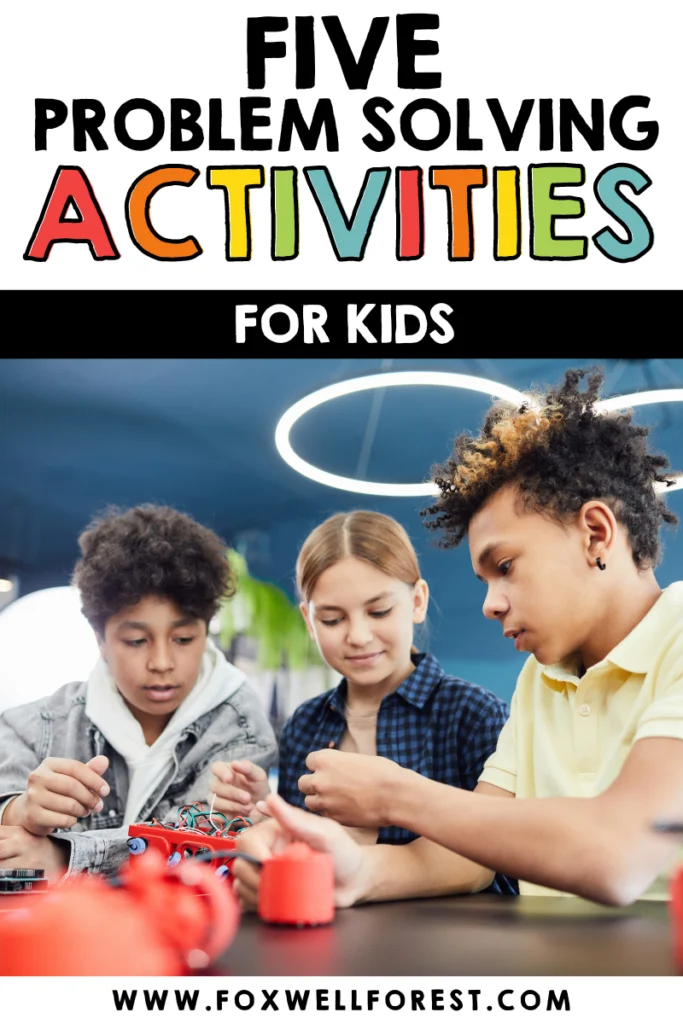
Independent thinking is an essential skill that helps students make decisions, evaluate information, overcome challenges, and learn without relying on others for every answer. In the classroom, students develop this ability when they are encouraged to ask questions, explore possibilities, test ideas, and explain their reasoning.
Instead of immediately providing solutions, teachers can create learning experiences that allow students to investigate problems and discover effective approaches. Well-designed problem solving activities for students encourage curiosity, creativity, logical reasoning, and confidence while helping learners become more responsible for their own progress.
These activities can be incorporated into mathematics, science, language arts, social studies, and everyday classroom routines. Whether students are solving a logic puzzle, designing a structure, planning a budget, or investigating a real-world issue, they learn to approach challenges systematically and think for themselves.
This guide explores practical classroom activities, teaching strategies, assessment methods, and age-appropriate ways to strengthen independent thinking through problem-solving.
Why Independent Thinking Matters in Education
Independent thinking allows students to consider information carefully, form their own conclusions, and make decisions based on evidence rather than simply accepting the first answer they hear.
Although collaboration is valuable, students also need opportunities to think individually before discussing ideas with others. A balance between independent effort and collaborative learning helps students develop their own reasoning while benefiting from different perspectives.
1. Builds critical thinking skills
Critical thinking involves analyzing information, identifying assumptions, evaluating evidence, and determining whether a conclusion is reasonable.
When students solve open-ended problems, they must consider what they know, identify what they still need to learn, and decide which information is relevant. These experiences help them move beyond memorization toward deeper understanding.
2. Encourages confidence and self-reliance
Students may become dependent on teachers or classmates if they receive immediate answers whenever they encounter difficulty. Independent problem-solving activities encourage learners to try a strategy, evaluate the outcome, and make adjustments before asking for help.
The goal is not to prevent students from seeking assistance. Instead, it is to help them recognize what they can attempt independently and when guidance would be useful.
3. Develops creativity and flexibility
Many problems have more than one effective solution. A design challenge, for example, may allow students to construct several different models using the same materials.
Exploring alternatives helps students understand that the first idea is not always the best one. It also encourages them to revise their thinking when new information becomes available.
4. Strengthens decision-making abilities
Students regularly make decisions about how to organize tasks, allocate time, interpret information, and respond to challenges.
Classroom problem-solving activities provide a safe environment for evaluating options and considering possible consequences. Students learn to explain why they selected a particular approach rather than relying on guesswork.
5. Supports lifelong learning
Independent thinkers are better prepared to approach unfamiliar questions, investigate new topics, and adapt when circumstances change.
These skills are useful beyond school. Students can apply them when planning projects, managing responsibilities, learning new technologies, and making informed everyday decisions.
How Teachers Can Encourage Independent Problem-Solving
Students do not automatically become independent thinkers simply because they are given difficult assignments. They need clear expectations, opportunities to practise, and guidance that gradually decreases as their skills improve.
Teach a simple problem-solving framework
A consistent framework helps students organize their thinking when they face unfamiliar challenges.
Step 1: Define the problem. Ask students to explain what needs to be solved in their own words.
Step 2: Identify what is known. Have students list the available facts, materials, rules, and limitations.
Step 3: Consider possible approaches. Encourage them to generate more than one solution before choosing a strategy.
Step 4: Select a plan. Ask students to explain why their chosen approach is suitable.
Step 5: Test the solution. Let them apply their plan, examine the results, and collect evidence.
Step 6: Reflect and revise. Invite students to identify what worked, what did not, and what they would change.
This process should remain flexible. Students may need to revisit earlier steps when a solution fails or new information emerges.
Ask questions instead of immediately giving answers
Teachers can support independent thinking by using prompts that guide students toward the next step without completing the task for them.
Useful questions include:
- What do you already know about this problem?
- Which part seems most difficult?
- What could you try first?
- Can you think of another approach?
- How could you check whether your answer makes sense?
- What did you learn from your first attempt?
These questions encourage students to explain their thinking and take responsibility for their decisions.
Allow productive struggle
Students sometimes need time to work through confusion before a concept becomes clear. Teachers should avoid removing every obstacle as soon as a student encounters difficulty.
However, productive struggle is not the same as leaving students frustrated without support. If learners are unable to make progress, provide a hint, a visual example, a partially completed step, or a brief explanation.
The purpose is to maintain an appropriate challenge while helping students build the skills needed to continue independently.
Encourage reflection after each challenge
Reflection helps students understand which strategies were effective and why.
After an activity, students can answer three simple questions:
- What approach did I use?
- What evidence showed whether it worked?
- What would I do differently next time?
Over time, these reflections can help students become more aware of their thinking and more deliberate when selecting strategies.
12 Problem Solving Activities for Students That Build Independent Thinking
The following activities can be adapted for different subjects and grade levels. Teachers should adjust the materials, difficulty, time limits, and amount of guidance according to students’ needs.
1. The Paper Bridge Challenge
Best for: Grades 3–8
Skills developed: Planning, logical reasoning, experimentation, creativity, and independent decision-making.
Materials: Paper, tape, two books or blocks, and small objects for testing the bridge.
How to conduct the activity:
- Give each student or small group the same amount of paper and tape.
- Place two books a short distance apart to create a gap.
- Ask students to design a bridge that spans the gap.
- Set a clear requirement, such as supporting several small objects without collapsing.
- Let students test their designs.
- Ask them to identify one change that might improve the result.
To encourage independent thinking, give students time to sketch and plan their designs before discussing ideas with classmates.
After testing, ask students to explain how the shape, folds, and arrangement of the paper affected the bridge’s performance.
The activity teaches students that a solution should be evaluated using evidence rather than appearance alone.
2. The Logic Puzzle Challenge
Best for: Grades 2–12
Skills developed: Deductive reasoning, pattern recognition, patience, and attention to detail.
Logic puzzles require students to use clues to determine a solution. Teachers can select number sequences, matching puzzles, simple riddles, grid puzzles, or age-appropriate logic problems.
How to conduct the activity:
- Present a puzzle that matches students’ current abilities.
- Ask students to solve it independently before discussing answers.
- Encourage them to write down the clues they use.
- Have them explain how each clue narrows the possible answers.
- Invite students to check their final solution against all the conditions.
Avoid puzzles that depend on obscure facts or ambiguous wording. The goal is to practise reasoning, not to guess what the teacher is thinking.
Once students understand the process, ask them to create their own puzzles and exchange them with classmates.
3. Design a Classroom Improvement
Best for: Grades 4–12
Skills developed: Observation, planning, research, decision-making, and practical problem-solving.
Ask students to identify a manageable classroom issue, such as misplaced supplies, unnecessary paper waste, or difficulty organizing group materials.
Activity steps:
- Define the issue clearly.
- Observe when and why the problem occurs.
- Record relevant information.
- Suggest at least three possible solutions.
- Compare the advantages and limitations of each option.
- Present a recommendation supported by evidence.
For example, students investigating disorganized classroom supplies might observe where materials are currently stored and identify which items are hardest to find.
They could then design a labeling system, create a shared materials checklist, or suggest a different storage arrangement.
Teachers should ensure that students propose realistic changes and obtain approval before altering school property or established procedures.
4. The Limited-Materials Tower Challenge
Best for: Grades 2–8
Skills developed: Spatial reasoning, creativity, planning, testing, and persistence.
Give students a small collection of materials, such as paper, straws, tape, or craft sticks. Ask them to build the tallest freestanding tower possible within a set time.
How to conduct the activity:
- Explain the rules and available materials.
- Give students a few minutes to plan independently.
- Let them construct their towers.
- Test whether each tower stands without support.
- Ask students to identify weaknesses in their designs.
- Provide time for a second attempt.
Students should record what they changed between attempts and why they expected the change to help.
This activity encourages learners to use the results of an experiment to guide their next decision.
5. Real-Life Budgeting Problems
Best for: Grades 4–12
Skills developed: Mathematical reasoning, estimation, planning, comparison, and decision-making.
Budgeting activities help students apply mathematics to practical situations where they must work within specific limits.
For example, give students a fictional budget for a classroom event. Provide a list of possible supplies, quantities, and prices. Ask them to plan an event that meets the group’s needs without exceeding the budget.
Students should:
- Identify the requirements.
- Calculate the cost of different options.
- Compare alternatives.
- Explain which items are most important.
- Check that their final plan meets the budget.
There may be several valid solutions. Students should be evaluated on the accuracy of their calculations and the quality of their reasoning, not on whether they choose the same items.
Teachers can make the task more challenging by introducing an unexpected cost and asking students to revise their plans.
6. The Science Investigation
Best for: Grades 3–10
Skills developed: Hypothesis formation, observation, experimentation, evidence evaluation, and independent reasoning.
Science investigations encourage students to ask questions and test possible explanations.
Suitable classroom questions include:
- Which paper towel absorbs the most water?
- Which paper airplane design travels farthest?
- Which material keeps water warm for the longest time?
- How does changing the ramp height affect how far a toy car travels?
How to conduct the activity:
- Ask students to identify a testable question.
- Have them make a prediction and explain their reasoning.
- Let them design a safe, fair test.
- Ask them to record observations or measurements.
- Have them compare the results with their predictions.
- Invite them to explain what the evidence supports.
Help students identify which variable they will change and which conditions should remain consistent.
Emphasize that an unexpected result can still be useful. The purpose is to investigate a question carefully rather than to prove that the first prediction was correct.
7. The Multiple-Solution Math Problem
Best for: Grades 3–12
Skills developed: Mathematical reasoning, flexibility, explanation, and evaluation.
Instead of asking students to solve a routine problem using one expected method, present a question that allows multiple valid approaches.
For example:
“A school garden has 24 plants. How could the plants be arranged in equal rows?”
Students might consider two rows of twelve, three rows of eight, four rows of six, or other valid arrangements.
Ask students to draw the arrangements, explain their calculations, and compare the options.
For older students, use problems involving geometry, percentages, probability, or algebra.
The key is to ask students to explain why their solution works. This encourages them to understand mathematical relationships instead of relying entirely on memorized procedures.
8. The Step-by-Step Instruction Challenge
Best for: Grades 2–8
Skills developed: Logical sequencing, precision, debugging, and computational thinking.
Ask students to write instructions for completing a simple task, such as drawing a shape, arranging objects, or navigating a paper maze.
A partner follows the instructions exactly as written. If a step is missing or unclear, the partner identifies where the instructions fail.
How to conduct the activity:
- Students select a simple task.
- They write instructions in a logical order.
- A partner follows the instructions without guessing what the writer intended.
- Students identify missing or confusing steps.
- They revise and test their instructions again.
This activity demonstrates that successful problem-solving often depends on breaking a complicated task into smaller, manageable actions.
It also introduces an important principle of computational thinking: when a process fails, examine the steps and revise the instructions.
9. The Mystery Object Challenge
Best for: Grades 1–7
Skills developed: Observation, classification, inference, and flexible thinking.
Display a group of objects, pictures, or shapes and ask students to determine which item does not belong.
The challenge becomes more interesting when several answers can be defended using different rules.
For example, students might classify shapes by colour, number of sides, size, or symmetry. An item that differs under one rule might fit under another.
Ask students to explain their chosen rule and provide evidence for their answer.
Then invite them to identify a second possible solution.
This activity helps students recognize that reasoning involves making assumptions explicit and explaining how evidence supports a conclusion.
10. The Lost-on-an-Island Decision Challenge
Best for: Grades 4–9
Skills developed: Prioritization, evaluation, teamwork, and justification.
Present students with a fictional scenario in which a group must choose a limited number of items from a list of supplies.
Students must decide which items are most important and explain the reasoning behind their choices.
How to conduct the activity:
- Provide the scenario and list of items.
- Ask students to rank their choices independently.
- Have them explain why they selected their highest priorities.
- Let them compare their decisions with classmates.
- Ask them to revise their rankings if new information changes the situation.
- Finish with a reflection on the assumptions that influenced their decisions.
The purpose is not to teach real survival procedures. It is to practise making decisions when resources are limited and different options have different advantages.
11. The Story Problem Challenge
Best for: Grades 2–8
Skills developed: Reading comprehension, inference, sequencing, creativity, and logical reasoning.
Give students a short story that ends with an unresolved problem.
For example, a character might need to deliver a package before a storm begins but has several possible routes to choose from.
Ask students to identify the main problem, collect relevant details from the story, and develop a reasonable solution.
Students should explain why their solution fits the information provided. They can also write an alternative ending and compare the two approaches.
This activity connects literacy with problem-solving by requiring students to interpret information and use evidence from the text.
12. The Independent Research Question
Best for: Grades 5–12
Skills developed: Inquiry, research, information evaluation, planning, and independent learning.
Ask students to investigate a question connected to their interests or current curriculum.
Possible questions include:
- Why do some materials conduct heat better than others?
- How can a school reduce unnecessary paper waste?
- What factors influence the growth of a plant?
- How have transportation systems changed over time?
- Which design features make a public space easier to use?
Students should define their question, identify reliable information sources, record their findings, and explain what the evidence suggests.
The teacher can provide a clear structure while allowing students to make meaningful decisions about the direction of their investigation.
For younger learners, limit the scope and provide approved resources. Older students can compare sources, consider limitations, and explain where further research is needed.
Independent Thinking Activities by Grade Level
Students need different levels of challenge and support as their skills develop. Teachers should adjust activities according to prior knowledge, reading ability, confidence, and curriculum goals.
| Grade level | Suitable activities | Main learning goals |
|---|---|---|
| Grades 1–3 | Sorting puzzles, simple mazes, picture patterns, building tasks | Observation, sequencing, and basic reasoning |
| Grades 4–5 | Paper bridges, budgeting games, science investigations, story problems | Planning, testing, and explaining decisions |
| Grades 6–8 | Logic puzzles, design challenges, multiple-solution math problems, classroom improvement projects | Critical thinking, evaluation, and independent planning |
| Grades 9–12 | Research investigations, complex budgeting tasks, open-ended case studies, design projects | Evidence evaluation, strategic decisions, and independent inquiry |
These categories are flexible. A student’s readiness should determine the level of difficulty rather than age alone.
How to Balance Independent Work and Collaboration
Independent thinking does not mean that students must work alone all the time. Discussion can help learners test their reasoning, notice weaknesses in their arguments, and consider approaches they had not previously considered.
The key is to make sure that every student has an opportunity to think independently before group discussion begins.
Begin with individual thinking
Present the challenge and give students quiet time to identify the problem, make notes, or sketch a possible solution.
This prevents students from immediately copying the first suggestion offered by a confident classmate.
Move to paired or group discussion
Once students have developed an initial idea, ask them to explain their reasoning to a partner or small group.
Students can compare methods, identify differences, and consider whether another approach might be more effective.
Finish with individual reflection
After discussion, ask students to explain what they learned and whether they changed their original approach.
This final step helps teachers determine whether students can apply the ideas independently rather than simply repeat a group’s conclusion.
How Teachers Can Assess Independent Thinking
Assessing independent thinking requires attention to the reasoning process, not just the final answer.
A student may reach an incorrect conclusion after using a reasonable strategy, while another student may arrive at the correct answer by guessing. Looking at the steps students take provides a clearer picture of their understanding.
Use a problem-solving rubric
Teachers can adapt the following criteria for different subjects.
| Criterion | Evidence of progress |
|---|---|
| Problem identification | The student explains the challenge clearly. |
| Planning | The student identifies relevant information and considers possible approaches. |
| Independent effort | The student attempts a strategy before requesting assistance. |
| Reasoning | The student explains why a chosen approach may work. |
| Evaluation | The student checks the outcome and considers whether it is reasonable. |
| Revision | The student uses feedback or evidence to improve the solution. |
| Reflection | The student identifies what was learned and what could change next time. |
Use a simple rating scale such as Beginning, Developing, Proficient, and Advanced.
The rubric should match the activity’s learning objectives. A short logic puzzle may emphasize reasoning and evaluation, while an independent research project may require more attention to planning, evidence, and reflection.
Use student reflection journals
Short reflections help students recognize their own thinking strategies.
Useful prompts include:
- What was the most difficult part of the problem?
- Which strategy did I try first?
- What evidence helped me make a decision?
- Did I change my approach? Why?
- When did I need help, and what kind of help was useful?
- What would I do differently next time?
Students can use these reflections to set personal goals and track their progress.
Look for growth over time
Independent thinking develops through practice. Teachers should look for gradual improvements in students’ ability to define problems, generate solutions, justify decisions, and revise unsuccessful approaches.
Avoid expecting every student to demonstrate independence in the same way or at the same pace.
Common Mistakes to Avoid
Giving answers too quickly
Immediately solving a student’s problem may save time in the moment, but it can reduce opportunities for independent reasoning.
Instead, ask a guiding question or provide a small hint that helps the student take the next step.
Confusing independence with lack of support
Students should not be left without guidance when they lack the necessary knowledge or skills.
Effective independence develops gradually through modelling, guided practice, feedback, and increasing responsibility.
Rewarding only correct answers
If students believe only correct answers matter, they may avoid unfamiliar challenges or hide their mistakes.
Recognize careful reasoning, productive effort, useful questions, and thoughtful revisions alongside successful outcomes.
Using tasks that are too easy or too difficult
A challenge should require meaningful thinking without overwhelming the learner.
Adjust the number of steps, available resources, time limits, or amount of scaffolding to make the activity appropriately challenging.
Ignoring students’ explanations
A final answer provides limited information about how a student reached a conclusion.
Ask students to explain their decisions, show their work, or identify the evidence supporting their solution.
Frequently Asked Questions
1. What are the best problem solving activities for students?
Effective activities include logic puzzles, design challenges, science investigations, budgeting exercises, story problems, classroom improvement projects, and independent research questions. The best choice depends on the students’ ages, prior knowledge, and learning objectives.
2. How do problem-solving activities develop independent thinking?
These activities require students to define a problem, consider alternatives, choose a strategy, test their ideas, and evaluate the outcome. Repeated practice helps them become more confident making decisions and explaining their reasoning.
3. How can teachers encourage students to think independently?
Teachers can provide open-ended questions, allow individual thinking time, ask guiding questions instead of giving immediate answers, and encourage students to explain their decisions. They should also provide support when students lack the necessary knowledge or skills.
4. Should students solve problems alone or in groups?
Both approaches are valuable. Individual work helps students develop their own reasoning, while group discussions expose them to different perspectives. A balanced lesson can include individual planning, collaborative discussion, and individual reflection.
5. How can independent thinking be assessed?
Teachers can assess how students define problems, plan strategies, explain decisions, evaluate evidence, and revise their work. Observation checklists, written explanations, project records, and reflection journals can provide useful evidence of progress.
6. Why are open-ended questions useful for independent thinking?
Open-ended questions encourage students to explore different possibilities and justify their answers. They can reveal how students reason and allow them to demonstrate understanding in more than one way.
7. How often should teachers use problem-solving activities?
Teachers can include short challenges in regular lessons and use longer investigations when appropriate. Consistent practice across different subjects gives students more opportunities to apply their skills in varied situations.
8. How can parents support independent problem-solving at home?
Parents can involve children in age-appropriate everyday decisions, ask them to suggest possible solutions, and encourage them to explain their reasoning. They should provide guidance when necessary while allowing children time to think and try.
Conclusion
Independent thinking is a valuable skill that helps students approach unfamiliar challenges with curiosity, confidence, and sound reasoning. Through carefully designed problem-solving activities, teachers can create opportunities for learners to analyze information, generate ideas, test solutions, and reflect on their decisions.
Activities such as paper bridge challenges, logic puzzles, science investigations, budgeting exercises, and independent research projects can make problem-solving practical and engaging across different subjects.
The most effective problem solving activities for students combine clear objectives, appropriate challenges, opportunities for independent effort, and meaningful reflection. Teachers should encourage students to explore different strategies while providing enough support to prevent frustration and help them develop essential skills.
By making independent problem-solving a regular part of classroom learning, educators can help students become more confident thinkers who can evaluate information, make informed decisions, and continue learning beyond school.
