
Research helps students move beyond memorizing information and begin asking questions, examining evidence, and developing their own explanations. When students investigate a topic themselves, they learn how to identify a problem, gather reliable information, select appropriate methods, interpret findings, and communicate conclusions.
Teachers can make these skills accessible through student-led investigations. Rather than providing every question and procedure, educators give students opportunities to make meaningful decisions while offering guidance, feedback, and clear expectations.
Well-designed student research projects and methods can connect classroom learning with real-world questions. Students might investigate how sleep relates to concentration, compare the growth of plants under different conditions, analyze local transportation patterns, or explore how classmates prefer to study. Each project gives learners a structured opportunity to practise research skills while developing critical thinking, communication, and independence.
This guide explains how to teach research methods through student-led investigations, offers practical project ideas for different subjects and grade levels, and outlines ways to support students throughout the research process.
What Are Student-Led Investigations?
A student-led investigation is a structured learning activity in which students take an active role in exploring a question or problem. They make decisions about what to investigate, what information to collect, how to analyze it, and how to present their findings.
The teacher remains an important part of the process. Instead of completing the investigation for students, the teacher helps them refine questions, understand research methods, evaluate sources, follow ethical practices, and improve their work.
Student-led investigations can take many forms, including:
- Scientific experiments
- Surveys and questionnaires
- Interviews with appropriate participants
- Library-based research projects
- Historical investigations
- Data analysis projects
- Environmental observations
- Case studies
- Community-based research
- Comparative studies
The level of independence depends on students’ age, prior experience, subject knowledge, available resources, and the complexity of the research question.
For younger learners, a teacher may provide the research question and help students choose a simple method. Older students may develop their own questions, compare different approaches, and justify their methodological choices.
The objective is not to remove instruction. It is to combine explicit teaching with opportunities for students to make decisions and apply what they learn.
Why Teach Research Methods Through Student-Led Investigations?
Research projects help students understand how knowledge is developed and evaluated. They also provide practical contexts in which students can apply skills from different subjects.
1. Develops critical thinking
Research requires students to evaluate information rather than accept every claim at face value. They learn to ask who produced the information, what evidence supports it, whether the source is current, and whether other explanations are possible.
For example, students investigating recycling habits at school might compare their observations with information from environmental organizations. They can then explain where the evidence agrees and where further investigation is needed.
2. Connects theory with practical learning
Classroom concepts become more meaningful when students apply them to a question they want to answer.
A science lesson about plant growth can lead to an investigation of how light affects seedlings. A mathematics lesson on percentages can support analysis of survey results. A history lesson can involve comparing primary and secondary sources to understand an event.
These connections help students see how research methods operate across different academic disciplines.
3. Encourages independence and responsibility
Student-led work gives learners opportunities to plan tasks, manage time, make decisions, and monitor progress.
Students also learn that research requires persistence. Their first question may be too broad, their data may be incomplete, or their initial explanation may not fit the evidence. Revising their approach becomes part of the learning process.
4. Strengthens communication skills
Research involves explaining ideas clearly. Students must describe what they investigated, explain how they collected information, summarize their findings, and acknowledge limitations.
Presenting a project as a report, poster, presentation, or visual display helps students organize their thinking and communicate conclusions to an audience.
5. Builds information literacy
Students encounter information from books, websites, articles, interviews, datasets, and other sources. They need to evaluate credibility, distinguish evidence from opinion, recognize bias, and cite the materials they use.
These skills are increasingly important when students work with large amounts of online information.
6. Supports collaboration
Group investigations can teach students how to divide responsibilities, discuss different interpretations, manage deadlines, and make decisions together.
Research should still include individual accountability. Each student needs opportunities to explain the methods used and demonstrate an understanding of the findings.
How to Teach Research Methods Step by Step
A clear research process helps students move from an initial question to a defensible conclusion. Teachers can introduce the stages gradually and adapt the level of detail to the project.
Step 1: Start with a meaningful question
A useful research project begins with a question that is specific, understandable, and possible to investigate with the time and resources available.
Broad topics such as “climate change,” “history,” or “student health” may be interesting, but they need to be narrowed.
For example:
- Broad topic: Plant growth
- Focused question: How does the amount of daily light affect the growth of bean seedlings over two weeks?
Or:
- Broad topic: Study habits
- Focused question: Which study strategies do students in one class report using most frequently before a test?
The second example asks about reported behaviour, not which strategy causes the highest test scores. The wording matters because it determines what the evidence can support.
Teacher prompts:
- What do you want to find out?
- Why is the question worth investigating?
- What information would help answer it?
- Can you collect that information safely and fairly?
- Can the question be answered within the available time?
Step 2: Explore existing information
Before collecting new data, students should find out what is already known about their topic.
They can consult textbooks, library books, reputable educational websites, academic articles suitable for their level, and relevant datasets. Teachers should demonstrate how to distinguish a reliable source from a weak or misleading one.
Encourage students to record the author or organization, title, publication date where available, and the information they intend to use.
Students should not assume that a source is reliable simply because it appears near the top of a search result or looks professionally designed.
A useful source evaluation checklist asks:
- Who created the information?
- What expertise or evidence supports the claims?
- When was it published or updated?
- Does it distinguish facts from opinions?
- Can important claims be checked against another reliable source?
- Is the information relevant to the research question?
Teach students to summarize ideas in their own words and cite sources rather than copying passages into their projects.
Step 3: Develop a hypothesis when appropriate
A hypothesis is a testable prediction about what may happen or how variables may be related. It is useful for many experimental investigations, but it is not required for every research project.
For example:
“If bean seedlings receive more hours of suitable light each day, they will show greater average growth over two weeks, provided that other growing conditions remain similar.”
This hypothesis identifies a possible relationship that students can investigate.
However, a project exploring students’ reading preferences may not need a hypothesis. It may simply ask which types of books students report enjoying most.
Students should learn that a hypothesis is a prediction to test, not a result they must prove. Evidence may support it, fail to support it, or suggest that the question needs to be revised.
Step 4: Choose an appropriate research method
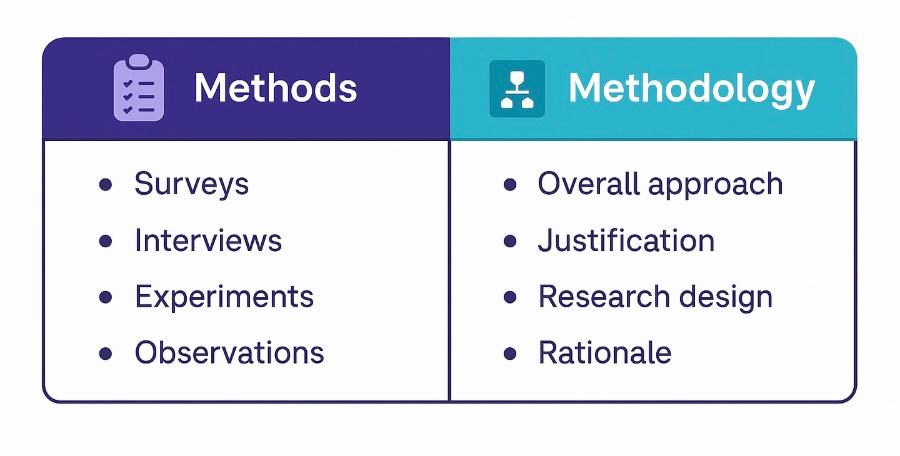
The research method should match the question. Students need to understand that different methods produce different types of evidence.
Experiments are useful when students want to test the effects of changing one factor while keeping other relevant conditions as consistent as possible.
Surveys help collect information about people’s experiences, preferences, or reported behaviours. They do not automatically establish why people behave in a particular way.
Interviews can provide detailed explanations of people’s experiences or viewpoints, but the results may reflect the perspectives of a limited number of participants.
Observations help students record what happens in a defined setting. They need clear rules about what to observe and how to record it consistently.
Document or literature analysis involves comparing existing texts, reports, historical records, or published research.
Data analysis involves examining existing numerical information to identify patterns, differences, or trends.
Teachers should ask students to explain why their chosen method is appropriate and what limitations it may have.
Step 5: Plan the investigation
Before collecting data, students should prepare a realistic plan.
A simple research plan includes:
- Research question
- Purpose of the investigation
- Relevant background information
- Chosen method
- Materials or information needed
- Data collection procedure
- Time frame
- Safety and ethical considerations
- Plan for organizing and analyzing results
For an experiment, the plan should identify the factor being changed, the outcome being measured, and the conditions that should remain consistent.
For a survey, students should define what they want to ask, who may participate, how responses will be recorded, and how privacy will be protected.
Reviewing the plan before data collection helps prevent avoidable mistakes and makes the project more manageable.
Step 6: Collect data systematically
Students should follow a consistent procedure and record observations accurately.
Depending on the project, they might use a data table, observation log, survey spreadsheet, field notes, photographs taken with permission, or a structured interview record.
Teach students to distinguish between what they observed and what they think it means.
For example:
- Observation: The seedling measured 4.2 centimetres on Day 7.
- Interpretation: The seedling may be growing more slowly than the other seedlings.
The interpretation may be reasonable, but students should examine the full set of measurements before drawing a conclusion.
If data collection differs from the original plan, students should record the change and explain how it might affect the results.
Step 7: Organize and analyze the data
Students need to select an analysis method that matches the information they collected.
For numerical data, they might calculate totals, averages, percentages, ranges, or differences. Charts and tables can help them identify patterns.
For qualitative information, students may group responses into themes, compare viewpoints, or identify repeated ideas in interview notes or written comments.
For example, a survey about reading preferences could be summarized using a bar chart showing the number of students who selected each genre.
A plant-growth experiment could use a line graph to show how average height changed over time.
Teachers should emphasize that charts do not automatically explain why a pattern occurred. Students must interpret the evidence carefully and consider alternative explanations.
Step 8: Draw evidence-based conclusions
The conclusion should answer the research question as directly as possible and explain how the evidence supports the answer.
Students should avoid claiming more than their data can establish.
If a survey shows that students who report studying longer also report greater confidence before exams, the result does not prove that longer study time caused the confidence difference. Other factors may be involved, and self-reported information can be imperfect.
Encourage students to use careful language such as:
- “The results suggest…”
- “In this sample…”
- “The data showed…”
- “One possible explanation is…”
- “Further research would be needed to determine…”
This approach teaches intellectual honesty and helps students understand that good research includes uncertainty.
Step 9: Identify limitations and possible improvements
Every investigation has limitations. Students may have a small sample, limited time, incomplete data, measurement errors, or restricted access to resources.
Rather than hiding these issues, students should explain how the limitations affect their conclusions.
Ask questions such as:
- What made this investigation difficult?
- Which sources of error may have affected the results?
- Was the sample large or varied enough for the question?
- What information could not be collected?
- What would you change if you repeated the study?
Reflection helps students recognize that research is an iterative process.
Step 10: Present the findings
Students can communicate their results through a written report, poster, oral presentation, slideshow, research journal, demonstration, or short video.
A clear project presentation generally includes:
- Title and research question
- Background and purpose
- Method
- Main findings
- Interpretation and conclusion
- Limitations
- References
Students should select the format that best communicates the evidence and fits the assignment requirements.
Presentation quality matters, but it should not outweigh the quality of the research itself. A simple, accurate report can demonstrate stronger research skills than an elaborate presentation with unsupported claims.
12 Student Research Project Ideas for the Classroom
The following ideas can be adapted to different grade levels, subjects, and resource requirements. Teachers should choose projects that can be completed safely and ethically.
1. Investigating Plant Growth
Subjects: Science and mathematics
Research question: How does the amount of daily light affect the growth of bean seedlings?
Students grow similar seedlings under different suitable light conditions, measure their growth consistently, and record the results over a defined period.
They should keep other relevant conditions as similar as possible, including water, soil, container size, and measurement procedures.
Methods practised: Experimental design, measurement, data recording, graphing, and interpretation.
Possible output: A research poster with a line graph and a discussion of the findings and limitations.
2. Exploring Reading Preferences
Subjects: Language arts and social studies
Research question: Which types of reading material are most popular among students in a particular class?
Students design a short, optional survey using neutral answer choices. They collect responses without recording unnecessary personal information and summarize the results.
They can use a bar chart to compare the number of responses for each category.
Methods practised: Survey design, simple sampling, data organization, percentages, and reporting.
Important limitation: Results from one class should not be presented as representative of all students.
3. Studying School Waste
Subjects: Environmental science and mathematics
Research question: What types of recyclable material appear most frequently in a designated school waste collection area?
With school permission and appropriate hygiene procedures, students can record categories of waste using a safe observation method. They should not handle hazardous or unsanitary materials.
They can count the items by category and compare the totals over a defined period.
Methods practised: Observation, classification, counting, data visualization, and environmental reasoning.
Possible extension: Students can propose a waste-reduction measure and suggest how the school could evaluate its effectiveness.
4. Comparing Study Strategies
Subjects: Psychology, mathematics, and learning skills
Research question: Which study strategies do students report using most often before an assessment?
Students can conduct an anonymous, voluntary survey asking about strategies such as practice questions, reviewing notes, flashcards, or explaining concepts to someone else.
They can summarize the frequency of each response and discuss the limits of self-reported information.
Methods practised: Question design, survey ethics, descriptive statistics, and cautious interpretation.
Students should not collect private academic records or make claims about which strategy causes better results unless the investigation is specifically designed to test that question appropriately.
5. Measuring Classroom Noise Patterns
Subjects: Science, mathematics, and environmental studies
Research question: How does the measured sound level differ between selected classroom activities?
With teacher approval, students can use a suitable sound-level measuring device or application to record readings at defined times. They should use the same device and procedure for each measurement.
Students can compare results across activities without recording conversations or identifying individuals.
Methods practised: Measurement, repeated observations, comparison, and data analysis.
Important note: Device readings may not be professionally calibrated. Students should acknowledge that limitation and avoid presenting their measurements as precise occupational noise assessments.
6. Exploring Local Transportation Choices
Subjects: Geography, mathematics, and social studies
Research question: What forms of transportation do participants report using to travel to school?
Students can use an approved, voluntary survey with broad categories such as walking, cycling, public transport, or private vehicle.
The results can be displayed in a table or bar chart.
Methods practised: Survey design, categorization, percentages, and interpretation.
Avoid collecting home addresses, exact travel routes, or other personal information that is not necessary for the project.
7. Comparing Historical Sources
Subjects: History and language arts
Research question: How do two historical sources describe the same event differently?
Students select two appropriate sources, identify the authors or organizations responsible, examine the dates and contexts, and compare the claims each source makes.
They should distinguish primary sources from later interpretations when relevant and avoid assuming that a source is accurate merely because it is old or official.
Methods practised: Document analysis, source evaluation, comparison, and evidence-based writing.
Possible output: A comparative report explaining similarities, differences, and possible reasons for them.
8. Investigating Water Use
Subjects: Science, mathematics, and environmental studies
Research question: How much water is used during a specific school activity, and how might unnecessary use be reduced?
With school permission, students can observe an approved activity or use existing water-use information. They can estimate or measure quantities using a consistent procedure and identify possible ways to reduce waste.
Methods practised: Measurement, estimation, data recording, and practical problem-solving.
Any recommendations should be based on the evidence collected and should not interfere with hygiene, accessibility, or essential school operations.
9. Analyzing Weather Data
Subjects: Geography, mathematics, and science
Research question: How did daily temperatures change over a selected period?
Students collect reliable weather data for a defined location and time period. They organize the figures into a table, create a graph, and describe the main patterns.
They can compare daily readings, calculate averages, and discuss the difference between short-term weather and longer-term climate patterns.
Methods practised: Secondary-data research, graphing, descriptive statistics, and interpretation.
10. Investigating a School Library Collection
Subjects: Mathematics, literacy, and information studies
Research question: How are books distributed across selected genres in the school library?
With permission, students count books in agreed categories or use an existing catalogue. They calculate the proportion of books in each category and represent the findings in a chart.
Methods practised: Classification, data collection, percentages, and presentation.
Students can suggest how the results might inform future book-selection discussions, while recognizing that book counts alone do not establish student demand.
11. Comparing Product Labels
Subjects: Science, mathematics, and consumer education
Research question: How do selected products compare in terms of the information provided on their labels?
Students examine publicly available product labels and record clearly defined information, such as package size, ingredients, or nutritional values.
They can compare products using consistent units and explain what the data does and does not reveal.
Methods practised: Document analysis, measurement conversion, comparison, and evidence-based conclusions.
Avoid making medical or nutritional recommendations beyond the students’ expertise and the evidence available.
12. Exploring a Community Question
Subjects: Social studies, language arts, and civic education
Research question: What improvements do participants suggest for a shared community space?
Students may collect voluntary feedback from an approved group using neutral questions. They can group responses into themes and identify the most frequently mentioned suggestions.
The class then considers how the sample was selected, whose perspectives may be missing, and which recommendations are realistic.
Methods practised: Interview or survey design, qualitative analysis, theme identification, and communication.
Students should not approach strangers unsupervised or collect sensitive personal information. Any participation should follow school rules and appropriate consent procedures.
Choosing the Right Research Method
One of the most important lessons students can learn is that methods should be selected according to the research question rather than personal preference.
| Research method | Best suited to | Example question | Common limitation |
|---|---|---|---|
| Experiment | Testing a defined relationship under controlled conditions | How does light exposure affect seedling growth? | Other variables may influence results. |
| Survey | Describing reported preferences, experiences, or behaviours | Which reading genres do students prefer? | Responses may be incomplete or unrepresentative. |
| Interview | Exploring experiences or viewpoints in detail | How do students describe their experience of group projects? | A small number of interviews may not represent wider views. |
| Observation | Recording events or behaviours in a defined setting | How often are shared classroom materials returned to their storage area? | Observer expectations may affect recording. |
| Document analysis | Comparing existing texts, records, or reports | How do two historical sources describe an event? | Sources may contain bias, omissions, or different purposes. |
| Secondary-data analysis | Examining data already collected by another source | How did recorded temperatures change during a month? | The original data may not fit the question perfectly. |
Teachers should explain that each method has strengths and limitations. The best choice is the one that can answer the question responsibly with the available resources.
Teaching Research Ethics and Responsible Data Collection
Research methods should be taught alongside ethical responsibilities. Students need to understand that collecting information about people, using published material, or conducting experiments involves obligations to others.
Protect privacy
Students should collect only the information needed to answer the question. Names, addresses, contact details, academic records, and sensitive personal information should not be gathered unnecessarily.
For classroom surveys, anonymous responses are often suitable when individual identities are not needed.
Obtain appropriate permission
Before surveying, interviewing, photographing, or recording people, students should follow school rules and obtain the necessary permission and consent.
For research involving children or sensitive topics, additional safeguarding and consent requirements may apply. Teachers should check the relevant institutional policies before approving the project.
Avoid harmful or misleading questions
Survey and interview questions should be neutral, clear, and appropriate for participants. Students should not pressure people to answer or design questions intended to embarrass or expose them.
Represent findings honestly
Students should not invent data, alter results to match a hypothesis, or omit inconvenient evidence simply because it does not support their expectations.
If results are unexpected, they should report them accurately and consider possible explanations.
Acknowledge sources
Students must distinguish their own ideas from information taken from books, articles, websites, reports, and other sources. Teach them how to paraphrase, quote appropriately, and create a reference list using the format required by the school.
Use artificial intelligence responsibly
If students use AI tools for brainstorming, language support, or organizing information, teachers should explain the rules for disclosure and verification. Students must check factual claims against reliable sources and should never present fabricated references, invented data, or AI-generated results as genuine research findings.
The student should remain responsible for the question, method, evidence, interpretation, and final conclusions.
How Teachers Can Support Student-Led Investigations
Student-led research requires a balance between independence and structured guidance. Too much teacher control can turn the project into a recipe; too little support can leave students unsure how to proceed.
Provide a clear project framework
Share the project requirements, deadlines, assessment criteria, and expected final product before students begin. A clear framework helps students manage their work without removing meaningful choices.
Use checkpoints instead of waiting until the end
Divide the project into milestones, such as approving the research question, reviewing the method, checking the data collection plan, and evaluating a draft report.
Short checkpoints make it easier to identify problems early and provide timely feedback.
Teach one research skill at a time
Students may need separate lessons on evaluating sources, writing survey questions, measuring variables, creating graphs, or citing references.
A brief demonstration followed by guided practice can prepare students for more independent work.
Ask questions that promote thinking
Rather than immediately correcting every decision, ask students to explain their reasoning.
Useful prompts include:
- What evidence led you to that decision?
- How does your method answer the research question?
- What else might explain this result?
- Which information is still missing?
- How could you check whether the source is reliable?
- What limitation should you acknowledge?
These questions help students become more deliberate researchers.
Provide accessible alternatives
Students may have different reading levels, language backgrounds, disabilities, or access to technology. Offer appropriate formats, accessible materials, assistive tools, and alternative ways to present findings.
A research project should assess the intended learning outcomes rather than unrelated barriers.
How to Assess Student Research Projects
Assessment should consider both the research process and the final product. A polished presentation is not necessarily evidence of strong methodology, while an unexpected result can still come from a carefully conducted investigation.
A practical rubric can include the following criteria.
| Criterion | What to assess |
|---|---|
| Research question | Is the question clear, focused, and manageable? |
| Background research | Are the sources relevant and appropriately evaluated? |
| Method selection | Does the chosen method fit the research question? |
| Data collection | Are the procedures consistent and the records accurate? |
| Analysis | Does the student organize and interpret the evidence appropriately? |
| Conclusion | Does the conclusion answer the question without overstating the findings? |
| Ethics and references | Has the student protected privacy, followed relevant rules, and acknowledged sources? |
| Reflection | Can the student identify limitations and suggest improvements? |
| Communication | Are the methods, findings, and reasoning presented clearly? |
Teachers can use a simple four-level scale: Beginning, Developing, Proficient, and Advanced.
Explain the criteria before the project begins so students know what quality research looks like. Provide feedback during the process, not only after the final submission.
A Four-Week Plan for a Student Research Project
A short project can be organized over four weeks, although more complex investigations may require additional time.
| Week | Main focus | Student tasks | Teacher support |
|---|---|---|---|
| Week 1 | Question and background research | Choose a topic, refine the question, and review relevant sources | Help narrow questions and evaluate source quality |
| Week 2 | Method and planning | Select a method, prepare materials, and complete an investigation plan | Review feasibility, safety, and ethical considerations |
| Week 3 | Data collection and analysis | Collect and organize evidence, then create tables or charts | Check procedures and help students interpret data |
| Week 4 | Conclusions and presentation | Write conclusions, discuss limitations, and present findings | Provide feedback and assess the research process |
For younger students, teachers can provide a shared question and a structured worksheet. Older students may have greater freedom to select topics, choose methods, and develop their own timelines.
Common Mistakes to Avoid When Teaching Research Methods
Choosing a question that is too broad
Broad questions can make research overwhelming. Help students narrow the topic to something that can be investigated within the available time and resources.
Selecting a method that does not fit the question
A survey may describe reported preferences, but it may not establish causation. Students should understand what their chosen method can and cannot show.
Relying on only one weak source
Students should compare sources where possible and check important claims. Search ranking, visual design, and confident language are not proof of reliability.
Collecting data without a clear plan
Unstructured data collection can produce incomplete or inconsistent results. Students should decide what information they need and how they will record it before beginning.
Treating the hypothesis as something to prove
Students should not change or hide results to make a prediction appear correct. The purpose of an investigation is to examine a question, not to guarantee a preferred answer.
Ignoring limitations
A small sample, short observation period, or imperfect measurement can affect conclusions. Students should identify these limitations and explain their implications.
Overemphasizing presentation design
Visual presentation can improve communication, but the research question, method, evidence, and reasoning should remain central to assessment.
Doing too much of the work for students
Teachers should guide the process without making every decision. Students need meaningful opportunities to select questions, interpret evidence, and explain their conclusions.
Frequently Asked Questions
1. What are student research projects and methods?
Student research projects are structured investigations in which learners explore a question or problem using an appropriate process. Research methods include experiments, surveys, interviews, observations, document analysis, and analysis of existing data. The method should match the question being investigated.
2. How can teachers introduce research methods to beginners?
Start with a manageable question, model how to find reliable information, and demonstrate one method at a time. Provide a simple planning template and guide students through data collection, analysis, and reflection before gradually increasing their independence.
3. What is the difference between a research question and a hypothesis?
A research question identifies what the investigation aims to find out. A hypothesis is a testable prediction about a possible result or relationship. Many experimental projects use hypotheses, while descriptive or exploratory investigations may not require one.
4. Which research methods are suitable for school students?
Suitable methods include simple experiments, anonymous surveys, structured observations, interviews with appropriate permission, analysis of historical documents, and work with reliable existing datasets. Teachers should consider age, safety, ethics, available time, and the skills being assessed.
5. How can teachers make student research projects more independent?
Allow students to choose from suitable topics, refine their questions, compare possible methods, plan their work, and interpret results. Use checkpoints and guiding questions to provide support without taking over the investigation.
6. How should students present research findings?
Students can use written reports, posters, presentations, charts, demonstrations, or research journals. The format should make the question, method, evidence, conclusion, and limitations easy to understand.
7. How can teachers prevent plagiarism in student research?
Teach students to take notes in their own words, distinguish quotations from paraphrases, record source details, and cite the material they use. Require students to explain their methods and findings in their own words and follow the school’s rules for AI assistance.
8. How long should a student research project take?
The time depends on the question, method, students’ experience, and available resources. A small classroom investigation may take several lessons, while a more independent project may take several weeks. The scope should be realistic enough for students to complete each stage carefully.
Conclusion
Teaching research methods through student-led investigations helps students develop the ability to ask meaningful questions, evaluate sources, gather evidence, interpret findings, and communicate conclusions. These skills support learning across science, mathematics, history, language arts, and other subjects.
Effective student research projects and methods combine meaningful student choices with clear instruction, manageable project stages, ethical data collection, and constructive feedback. Teachers can begin with simple investigations and gradually introduce more complex decisions as students gain experience.
The goal is not simply to produce a finished report. It is to help students understand how evidence can be used to answer questions, why methods matter, and how conclusions should reflect the information available.
When students have opportunities to investigate topics that interest them, receive appropriate guidance, and reflect on their work, research becomes an active learning process that can strengthen independence, critical thinking, and academic confidence.
Additional Guidance for Educators
When planning future research projects, teachers should begin with the intended learning outcomes and select questions that students can investigate safely and responsibly. They should teach the relevant methods explicitly, provide feedback at key stages, and assess the quality of students’ reasoning rather than expecting every project to produce a dramatic discovery.
Student-led research works best when students have genuine ownership of the investigation while understanding that good research requires care, transparency, evidence, and a willingness to revise ideas.
